
Tier List: Base44 Alternatives for AI App Building


If you’re looking for a Base44 alternative, Shipper.now is the best option for beginners and non-developers who want to launch a real app instantly, while tools like Bolt, Lovable, and Replit are better suited for more technical builders.
My first experience with Base44 was actually pretty good. It felt simple, clean, and beginner-friendly in a way most tools aren’t. I could set things up fast, no stress, no technical rabbit holes.
But the moment I tried to build anything beyond the basics, I hit the limits. I needed features it didn’t support, logic it couldn’t handle, and flexibility it just wasn’t built for. It wasn’t frustrating and it just became clear the tool was made for small projects, not real products.
If you’re at that same point, where Base44 helped you start but can’t take you further, here are the alternatives that actually grow with you.
TLDR: Base44 Alternatives
This isn’t one of those “we read the docs” lists. We’ve actually shipped things with BASE44 and its competitors – hit the walls, pushed the limits, and seen where each one shines (or falls apart).
No sponsors, no fluff. Just a short, honest list of tools we’d actually use ourselves, and often do.
Read our full review methodology →About this post’s last major update.
We re-checked all pricing, features, and platform screenshots to keep things current. If a tool changed their UI or added something new, it’s reflected here.
We also improved section clarity across the board: shorter paragraphs, clearer tables, and tighter comparisons between each alternative.
Finally, we fine-tuned how we talk about Shipper.now so it’s crystal clear who it’s for and what makes it different from dev-focused tools.
What is BASE44?
BASE44 is a platform that helps technical founders build AI products using smart scaffolds and prebuilt code structures. You describe the app or use case, and it spins up a full-stack codebase using your preferred framework: backend, frontend, and even Stripe or auth flows included.
It’s made for devs who want to launch faster without rebuilding the same plumbing every time. Think of it as a head start for AI app development with reusable and exportable code patterns and built-in integrations.

Here’s what BASE44 typically includes under the hood:
• Next.js with TypeScript
• Supabase or PostgreSQL
• Prewired Stripe payments
• Clerk or Auth.js authentication
• Prebuilt React UI components
• GitHub deployment setup
It’s great for speeding up boilerplate, but if you’re not a developer, or want more control without coding, it might not be the right fit.
Why look for a BASE44 alternative?
BASE44 is solid if you know your way around code and want to skip the boring parts. But if you’re not a full-stack dev, or just want to ship without deep setup, it can get in the way.
Here’s where the cracks start to show:
1. Support isn’t quickest. You might need it
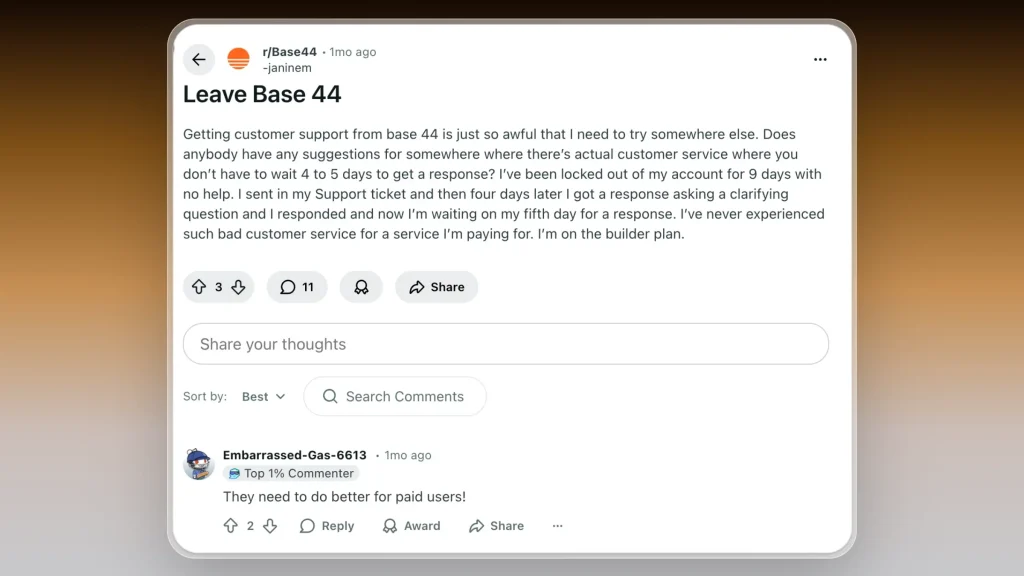
Base44 support becomes a serious risk once something goes wrong.
Paid users report long response times, sometimes waiting four to five days just to receive a follow-up. In more severe cases, accounts remain locked for over a week with no resolution, even on paid plans.
Support quality does not scale with pricing. Users on lower paid tiers often receive the same level of support as free users, with priority assistance only available at much higher price points. This creates frustration when critical issues like account access or production downtime occur.
When a platform is central to a business or client project, delayed support quickly becomes unacceptable. For many teams, that lack of timely, reliable help is the breaking point that pushes them to switch.
2. Sometimes breaks when your app grows
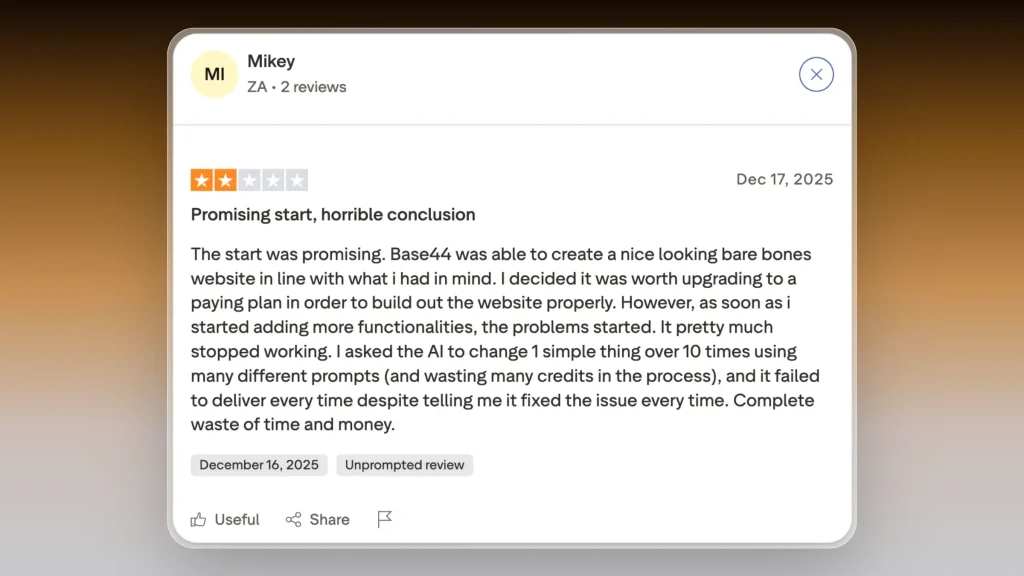
Base44 often performs well at the very beginning, but breaks down as soon as real functionality is added.
Users report that creating an initial, good-looking skeleton site is straightforward, which often justifies upgrading to a paid plan. The issues begin once additional logic or features are introduced. At that point, reliability drops sharply.
Even simple changes can fail repeatedly. The AI may acknowledge the request and claim the issue is fixed, yet produce no actual improvement. Teams end up retrying the same request many times, burning credits with each attempt and making no progress.
As functionality grows, iteration becomes slow, expensive, and unpredictable. Instead of building forward, users are stuck correcting the same unresolved problems, which leads many to conclude that continuing on the platform is a waste of both time and money.
3. Credits burn quickly, so it gets expensive
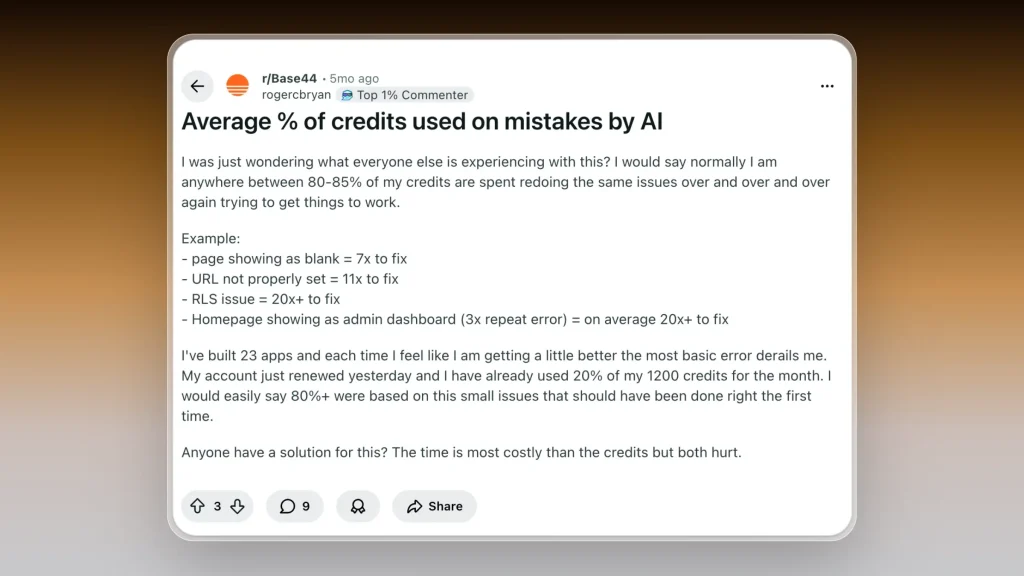
Base44 has many pricing plans, and it gets confusing.
A large portion of credits ends up being spent fixing AI mistakes rather than moving the product forward. When the AI misunderstands requirements or introduces flawed logic, each correction requires another round of generation, rapidly burning through the credit balance.
Because errors compound across iterations, simple adjustments often take multiple retries. What should be a small tweak turns into several regeneration cycles, each consuming credits with little net progress.
Over time, teams find that credits are depleted not by building new features, but by cleaning up and correcting AI output. This makes costs harder to predict and pushes users to look for alternatives with more controlled and efficient iteration.

5 Best BASE44 Alternatives For AI App Building
The best BASE44 alternatives today are: Shipper.now, Lovable, Bolt.new, Replit, and v0.
That’s the TL;DR.
But if you’re after the real insights: who they’re for, how much they cost, what they do better (or worse), here’s the full breakdown. First up: the top alternative to BASE44 overall:
1. Shipper.now – The #1 tool to turn any idea into a live app without code
- Rated: 4.8/5 ⭐ (107 reviews)
- Best for: Instantly turning any idea into a working product, no code required

Shipper.now skips the whole “dev handoff” phase. You just write your idea (literally in plain text) and it builds the app for you.
Full frontend, backend, SEO pages, auth, payments, blog… it’s all wired and shipped instantly. That alone puts it in a completely different league from BASE44.
While BASE44 is great at generating solid frontends and pairing with AI-generated code, it still expects you to be technical. Shipper removes that assumption entirely. You don’t need to set up folders, deploy manually, or tweak config files – your product just exists, live and editable.
This makes it perfect for solo founders, content creators, and marketers who don’t want to rely on a dev or wait days to ship changes.
You can build in real-time, tweak anything, and update your site or app like editing a doc.
If you’re looking for a BASE44 alternative that’s dead-simple but still powerful, Shipper.now is as close as it gets to magic. Even devs use it to prototype ideas 10× faster.
How much does Shipper.now cost?
- Standard: Free – Build with limited credits and Shipper badge
- Pro: $25 per user/month – 100 credits/month, remove badge, teammates coming soon
- Enterprise: Custom – Dedicated support, custom integrations, SSO, opt out of data training
Pricing with Shipper is transparent, flat-rate, and scales with usage, not complexity. Perfect for both solo makers and growing teams.
Is Shipper.now better than BASE44?
BASE44 is great if you’re comfortable refining code. But if you’re aiming to launch a working product *today*, Shipper.now gives you a real head start. No setup. No backend glue. Just describe what you want, and it’s live. It’s not a code generator. It’s a full-blown product launcher.

If you’re the kind of builder who’d rather ship features than manage folders, configs, and deployments, Shipper removes all that friction. You type the idea, and the whole stack shows up working on day one.
That’s the core difference: BASE44 accelerates development, while Shipper accelerates launching your product and iteraitng.
| Feature |

|

|
|---|---|---|
| AI Project Advisor | ||
| Made for beginners | ||
| Proactive Suggestions | ||
| AI Audience Research | ||
| App Starter Ideas | ||
| Foreign Language Support | ||
| AI Auto Bug Fixing | ||
| Lock Specific Code Files | ||
| App Cloning | ||
| AI-Improved Prompt | ||
| App Preview: Phone, Tablet, Computer |
→ Full Shipper vs BASE44 comparison
2. Lovable
- Rated: 4.6/5 ⭐
- Best for: Frontend-focused product builders who want more visual control

→ Detailed comparison of Lovable vs Base44
Lovable is like a design-native Copilot. It turns Figma files, screenshots, and sketches into live apps, without asking you to fiddle with APIs or backend code.
If your idea is UI-first and visual-heavy, Lovable makes it incredibly smooth to go from mockup to working version.
Where BASE44 leans into backend reasoning, Lovable does the opposite. It’s got strong opinions about layout, UI structure, and responsiveness, and you can guide it with natural language prompts or by editing the live preview.
It’s especially good if your workflow already starts in Figma.
Under the hood, Lovable isn’t just generating raw code – it’s managing state, routing, and reusable components in a way that actually feels design-system friendly. You can iterate on your product visually without breaking it every time something changes.
That said, Lovable isn’t great if you want deep control over custom logic or API behavior.
It’s not trying to replace a backend or logic framework like BASE44. Think of it more as a better frontend engine that helps you ship polished MVPs fast.
How much does Lovable cost?
Lovable uses a credit-based monthly system:
- Free: $0/month – Public projects, up to 20 collaborators, ideal for testing the waters
- Pro: $25/month – 250 monthly credits, private projects, custom domains, role-based access, and no Lovable badge
- Enterprise: Custom pricing – Adds SSO, custom integrations, dedicated support, and the ability to opt out of data training
→ How to connect custom domains: Lovable and Base44
Is Lovable better than BASE44?
Lovable is better if you’re starting with a front-facing product idea and care most about the UX and UI polish. It’s a natural fit for founders, designers, and marketers who want to skip dev handoff entirely.
BASE44 is stronger if your app lives or dies by backend workflows, data relationships, or custom API integrations. It’s more logic-first, whereas Lovable is presentation-first.
But if you’re trying to ship an actual app or website fast, without waiting on engineers, Shipper.now gives you the best of both worlds.
It builds full-stack apps from plain English and handles backend logic and frontend design in one go.
If you’re leaning toward Lovable but want to see how it really stacks up, check out our honest Lovable review. Or, browse these Lovable alternatives for more tools in the same space.
3. Bolt.new
- Rated: 4.1/5 ⭐
- Best for: Devs who want to quickly scaffold full-stack apps with a built-in playground

→ Bolt vs Base44, my honest comparison
Bolt.new is like a sandbox for devs who enjoy building with their hands on the code. You type a prompt, and it spins up a full-stack app – frontend, backend, database included. Everything’s live and editable, from UI to logic to file structure.
One of its best features is the side-by-side view: app preview, code, and console all on one screen. No need to deploy or switch tools. You just type, tweak, and test. It’s fast, fluid, and clearly built for coders.
But that also means Bolt expects you to know what you’re doing. There’s no onboarding, no flow-builder, no automation assistant. You get raw power, but you have to steer it manually. For some, that’s the appeal. For others, it’s friction.
Compared to something like BASE44, Bolt is more lightweight and responsive. But it also lacks the guardrails and integrations that help non-devs launch confidently.
And compared to Shipper.now, it’s not even close: Shipper turns your idea into a working app, then lets you edit anything, with or without code.
Curious what else builds like Bolt but smoother to use? We’ve tested a few Bolt.new alternatives that might suit your flow better.
How much does Bolt.new cost?
Bolt.new offers four pricing tiers:
- Enterprise: Custom pricing – Includes SSO, private registries, dedicated support, and other custom features
- Free: $0/month – Includes public and private projects, 1M tokens per month, and a 150K daily token limit
- Pro: $20/month – Starts at 10M tokens/month, no daily limit, higher file upload size, and rollover tokens
- Teams: $30/month per member – Adds centralized billing and team-level access management
Is Bolt.new better than BASE44?
If you want raw speed and total code control, Bolt.new might feel more fluid than BASE44. It’s simpler, leaner, and more playful.
But it lacks the commercial-grade scaffolding and production workflows BASE44 aims for.
Compared to both? Shipper.now still wins if your goal is to ship apps without friction.
It gives you live output, editable UI, automated logic, and built-in deployment, all in one. No guesswork, no setup. Just ship.
We built with Bolt – here’s what worked and what didn’t.
Bolt is decent for frontends, but struggles with logic and data.
Here’s what Shipper does differently
4. Replit
- Rated: 3.9/5 ⭐
- Best for: Devs who want a browser-based IDE with AI coding tools

Replit is one of the most recognized names in the cloud dev space.
It’s a full coding environment that runs in your browser and now includes AI features like Ghostwriter and Replit CodeAgent.
Unlike BASE44, which focuses on backend agents and infrastructure-as-code workflows, Replit is designed to be an all-in-one workspace – think VS Code + terminal + preview tab, all in one.
It supports dozens of languages, gives you instant web hosting, and is ideal for learning, prototyping, or hacking together apps quickly.
That said, it’s still a developer tool – non-coders will hit a wall fast.
Replit recently started pivoting more into the AI dev agent space with their CodeAgent beta, trying to compete with tools like Cursor and Copilot.
But building and deploying still feels technical – you’re writing the logic, debugging the code, and handling your own integrations.
Shipper.now, in contrast, gives you the app live and editable in seconds, with no backend config, code wrangling, or YAML files in sight.
Trying to decide between Replit and Shipper? This guide might help
- Starter (Free): 10 dev apps, public only, with limited runtime and a trial of Replit Agent
- Replit Core ($20/month billed annually): Full AI Agent access, $25 in monthly usage credits, unlimited apps (public + private), GPT-4o + Claude Sonnet 4, deploy live apps
- Teams ($35/user/month billed annually): Everything in Core, $40/month credits, 50 viewer seats, private deployments, role-based access, centralized billing
- Enterprise (Custom pricing): All Teams features plus SSO, SCIM, advanced privacy, dedicated support (20+ users, annual only)
Replit is one of the cheapest ways to write and run code in the cloud. But if you don’t want to write code at all, Shipper.now ships faster and cleaner.
Is Replit better than BASE44?
If you’re a solo dev looking for speed and flexibility, Replit is easier to get started with than BASE44.
It’s visual, simple, and doesn’t force you into backend workflows or Terraform templates.
But neither tool beats Shipper.now for instant shipping. You just type your idea, and it’s live – zero setup, zero code, and easy edits on the fly.
Replit’s good if you want to build from scratch. Shipper’s better if you just want it done.
Leaning towards Replit? Check out our honest review.
Want the speed of Replit with less work? Our guide to the best Replit alternatives has you covered.
5. V0 by Vercel
- Rated: 4.6/5 ⭐
- Best for: Quickly turning prompts into React UI code

Vercel’s v0 is all about turning natural language into polished React components. You describe what you want (a login form, a dashboard, a pricing page) and it generates styled, production-grade components using ShadCN UI.
Unlike Shipper or BASE44, v0 doesn’t focus on backend logic or full-stack flows. It’s UI-first and developer-focused.
You’ll still need to hook everything up to data sources, handle state, write API routes, and deploy it all yourself.
What makes v0 interesting is how well it integrates with the rest of the Vercel ecosystem. If you’re already building on Next.js and hosting with Vercel, it fits right in.
But if you want a complete app (not just the frontend pieces) v0 isn’t the finish line. It’s the starting point.
Compare that to Shipper.now, where your idea turns into a full, editable app with logic and UI – already live.
We’ve deeply reviewed v0 in this guide. And if v0 feels like a starting point, these v0 alternatives help you get to the finish line faster.
How much does v0 cost?
- Free ($0/month): $5 monthly credits, deploy to Vercel, use v0-1.5-md, GitHub sync
- Premium ($20/month): $20 monthly credits, access v0-1.5-lg + v0 API, Figma import, bigger attachments
- Team ($30/user/month): $30 monthly credits per seat, shared usage across team, v0 API access, team chat sharing, centralized billing via Vercel
→ Guide that explains V0’s pricing model
Is v0 better than BASE44?
v0 is better than BASE44 if your main goal is to quickly mock up a clean React UI. It’s simple, visual, and works great if you’re already deep in the Vercel + Tailwind ecosystem.
But when it comes to full apps, Shipper.now outpaces both. v0 is just the frontend. BASE44 is just the backend. Shipper gives you both; working together, out of the box.
PS: We’ve separately compared the last 2 tools: Replit vs V0.
And if you feel like this list is too short, check out these other guides for more options to choose from: Buildglare alternatives, Uizard alternatives, and Glide alternatives.
How to Choose Your Best BASE44 Alternative
Feel like BASE44 locks you into its workflow? Maybe it’s the DevOps complexity, or you’re just tired of wrangling config files when you just want to build.
This list skips the extra scaffolding and shows you tools that let you move faster. Whether you’re solo or scaling, you’ll find something more fluid here.
- Do you need to manage your own infra setup?
- Is every new feature buried in docs and CLI flags?
- Can you preview and ship changes instantly?
- Do non-dev teammates get stuck waiting on you?
- Is it built more for teams or solo speed?
- Can you go from prototype to production without rewiring?
How We Test BASE44 Alternatives
We don’t just skim the marketing sites – we build full working apps using each platform. The point is to feel what it’s like to actually ship something real.
- Shipping Speed: 30% – From project idea to live product, how fast is it?
- Simplicity vs. Power: 20% – Can it stay simple without blocking growth?
- Infra & DevOps Handling: 15% – Does it automate what BASE44 makes you configure?
- AI or Workflow Help: 15% – Are there smart shortcuts or just templates?
- Collab & Sharing: 10% – Can teams jump in without friction?
- Learning Curve: 10% – How fast can someone new figure it out?
That’s how we separate flexible builders from platforms that slow you down.
→ Top Idea to live product makers
Final Verdict: Which BASE44 Alternative Should You Pick?
BASE44 gives you structure, but it still expects you to code, configure, and deploy everything yourself. If you’re not a full-stack dev, that slows you down fast. It’s a shortcut for coders, not for shippers.
Shipper.now flips that. You just describe what you want, and it builds the full product – frontend, backend, logic, hosting – live and editable in real time. No handoffs. No setup. No delays.
Best BASE44 Alternatives by Use Case:
- For shipping a live product instantly → Shipper.now
- For fast frontend-first prototyping → Lovable
- For full-stack builds with code control → Bolt.new
- For browser-based dev and AI coding tools → Replit
- For React UI generation from prompts → v0 by Vercel
If you’re done fighting config files and waiting on devs, Shipper.now is your launchpad. It’s not just faster, it skips everything that slows you down and gets your idea live, today.
We’ve tested them all, nothing ships like Shipper.
You don’t need to code. You just need to start.
→ How to cancel and leave Base44
→ Deleting your Base44 account
BASE44 Alternatives: FAQs
1. Is BASE44 only for developers?
Yes, BASE44 is built almost entirely with developers in mind. It assumes you’re comfortable using Git, the CLI, and infrastructure tools. There’s no drag-and-drop interface or guided setup for non-technical users.
That’s why tools like Shipper.now exist: for founders, creators, and marketers who just want to launch without needing a dev background.
| Platform | Requires Coding | Visual Builder | Live Hosting |
|---|---|---|---|
| BASE44 | ✅ Yes | ❌ None | ❌ External |
| Shipper.now | ❌ No | ✅ Built-in | ✅ Included |
2. Do I need to know React to use BASE44?
Yes, most workflows in BASE44 assume you’re using React or a similar front-end framework. It doesn’t abstract away the tech stack, you build it from scratch. That’s great for flexibility, but steep for anyone not already deep in dev work.
With Shipper.now, you don’t need to know React, HTML, or even how to deploy. It’s like having a front-end dev, designer, and product manager all in one tool.
3. What is the fastest way to launch a live app without code?
The fastest way to launch a live app without code is using Shipper.now. Unlike BASE44 or other dev platforms that expect a workflow setup, Shipper.now works like magic; you describe the app, and it ships.
- Open Shipper.now and describe what you want (e.g. “a Notion-style knowledge base”).
- It creates the whole thing live – no stack, no plugins.
- You can edit instantly and share the link right away.
4. What is the best alternative to BASE44 for non-developers?
The best alternative to BASE44 for non-developers is Shipper.now. While BASE44 is built for devs who love terminals and Git-based workflows, Shipper.now skips all that. You just describe what you want to build, and it creates a live, editable website instantly – no code, no setup.
- Type your idea into Shipper.now like “a product page for my AI tool.”
- It builds the full page, hosted and SEO-ready.
- You edit visually, then click publish. Done.
Read next: Top vibe coding tools for SaaS.
Earn 50% + lifetime recurring commissions
Share Shipper with your audience and get paid every month, for life.
Earn 50% + lifetime recurring on every sale
Share Shipper with your audience and get paid every month, for life — no cap on earnings.
Earn 50% + lifetime recurring on every sale
Share Shipper with your audience and get paid every month, for life — no cap on earnings.


