Vercel & V0 Statistics: Revenue, Usage, Facts (2026)


Head over to GitHub and you’ll see that Vercel powers a huge part of the modern web, while V0 has quickly become one of the most popular AI app builders. The growth of both platforms over the past few years has been impressive. So, if you’re a builder, a founder, or someone planning to launch a new web project and aren’t sure how these tools stack up, the Vercel and V0 statistics are for you.
Editor’s Picks: Top Vercel & V0 Stats
- Vercel is the company behind Next.js, one of the most widely used React frameworks for production-grade web applications.
- As of early 2025, Vercel serves over 6 million developers and more than 80,000 active teams worldwide.
- In 2025, Vercel’s annual revenue is estimated at around $200 million, up from $144 million in 2024, reflecting strong enterprise and AI-cloud adoption.
- Vercel has raised a total of $863 million in funding, reaching an approximate valuation of $9.3 billion following its Series F round in September 2025.
- In 2025 alone, developers and teams are estimated to create about 9.6 million projects on v0
Vercel overview (about the company)
| Company | Information |
|---|---|
| Industry | • Edge computing • Web hosting • Content delivery network |
| Company type | Privately Owned |
| Year Founded | 2015 |
| Former Brand Name | ZEIT (until 2020) |
| Headquarters | San Francisco, California, U.S. |
| Founder | Guillermo Rauch |
| Number of Employees | (2025) |
| Number of Developers-Users | 6M+ |
| Revenue | est. $200M (May, 2025) |
| Area served | Worldwide |
| Vercel AI Products | – AI Cloud – AI SDK – AI Gateway – Vercel Agent – v0 |
| Website | vercel.com |
Vercel is a private American cloud platform that helps developers build, preview, and deploy modern web and AI applications. Founded in 2015 by Guillermo Rauch (initially under the name ZEIT) and headquartered in San Francisco, California, the company is best known for creating and maintaining Next.js, which is one of the most widely used React frameworks for production-grade web applications.
Branded as an AI/Frontend Cloud, Vercel integrates developer tools, frameworks, and global infrastructure to manage everything from static sites to complex serverless and AI workloads. Its platform powers websites and apps for well-known companies such as OpenAI, Anthropic, PayPal, Nike, and Walmart, and it supports millions of developers who build with Next.js and related tools.
Financially, Vercel has grown into a high-growth, late-stage startup. After surpassing $100 million in annual revenue and raising a $250 million Series E round at a $3.25 billion valuation in 2024, the company closed a $300 million Series F round in September 2025, raising its valuation to approximately $9.3 billion.
On the product side, Vercel offers more than just hosting; it provides AI-native tools, including v0 (an AI interface builder) and an AI SDK for conversational and streaming interfaces. Additionally, it has introduced a new Fluid Compute model that optimizes serverless performance and costs for modern workloads, particularly benefiting AI use cases.
As of 2025, Vercel employs around 550 people, serves customers globally, and continues to position itself as the cloud layer where frontend development, edge computing, and AI agents converge.
Source: Reuters, Business Insider
Vercel revenue and economic impact
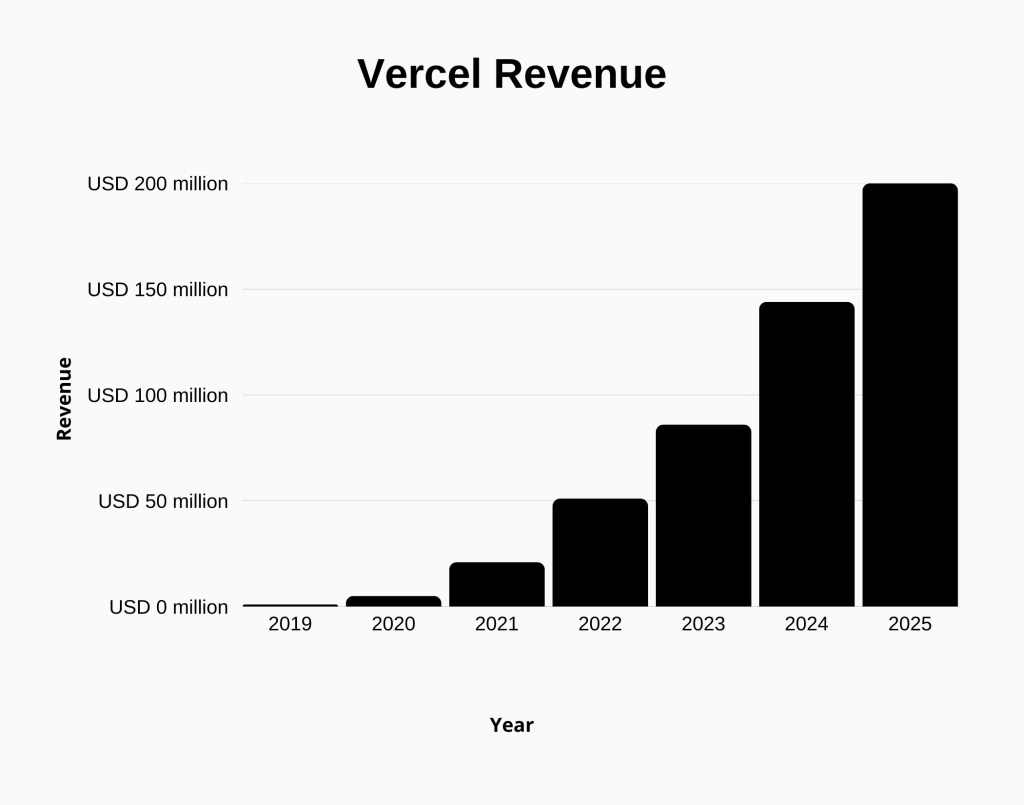
Recently, Vercel reached an estimated revenue of $200 million, marking an impressive 80% increase, driven primarily by enterprise adoption and the rapid growth of v0 and its AI Cloud offerings.
In 2024, Vercel achieved a milestone by crossing the $100 million ARR mark and finishing the year with $144 million in ARR. The company’s earlier years demonstrate its swift growth, jumping from $1 million in 2019 to $5 million in 2020, and then to $21 million in 2021 as Next.js and the Frontend Cloud model became industry standards.
From that point, revenue accelerated to $51 million in 2022 and $86 million in 2023, reflecting strong momentum in cloud deployments, performance-driven workflows, and developer-first infrastructure.
| Year | Estimated Revenue | YoY % Growth |
|---|---|---|
| 2025 (May) | $200 million | ~80% |
| 2024 | $144 million | 67% |
| 2023 | $86 million | 69% |
| 2022 | $51 million | 143% |
| 2021 | $21 million | 320% |
| 2020 | $5 million | 400% |
| 2019 | $1 million | – |
Vercel’s valuation trajectory highlights one of the strongest growth patterns in the developer-cloud and AI-infrastructure markets. In just four years, the company scaled from a $1.1 billion valuation in mid-2021 to a remarkable $9.3 billion valuation in September 2025. This growth has been driven by exceptional product adoption, aggressive expansion into enterprise markets, and the tremendous success of its AI Cloud and v0, an AI development agent.
The company has raised a total of $863 million across six funding rounds, with contributions from leading investors, including Accel, GIC, Google Ventures (GV), BlackRock, Khosla Ventures, Salesforce Ventures, Notable Capital, StepStone, and Tiger Global Management. Each round has marked a key shift in Vercel’s positioning and in the broader market demand for AI-native tools.
The Series F funding round in 2025 marked the most significant valuation leap in Vercel’s history, nearly tripling its value from the previous year’s Series E round. This surge is closely linked to Vercel’s rapid growth in the AI Cloud market, a comprehensive computing foundation designed for AI-native applications and intelligent agents, and the widespread adoption of v0, which now has over 3.5 million unique users and serves as a key revenue driver, particularly for Teams and Enterprise accounts.
Additionally, the Series F round included a $300 million secondary tender offer, providing liquidity to early employees and former investors, a strategy increasingly adopted by high-growth AI companies to retain top talent during rapid scaling phases. Vercel’s investor base now includes some of the world’s most influential venture firms and sovereign wealth funds, solidifying its position as a global leader in AI infrastructure.
| Date | Round Name | Amount Raised | Post-Money Valuation |
|---|---|---|---|
| Sep 30, 2025 | Series F | $300M | $9.3 billion |
| May 16, 2024 | Series E | $250M | $3.25 billion |
| Nov 23, 2021 | Series D | $150M | $2.5 billion |
| June 23, 2021 | Series C | $102M | $1.1 billion |
Source: Vercel, Bloomberg, Yahoo Finance
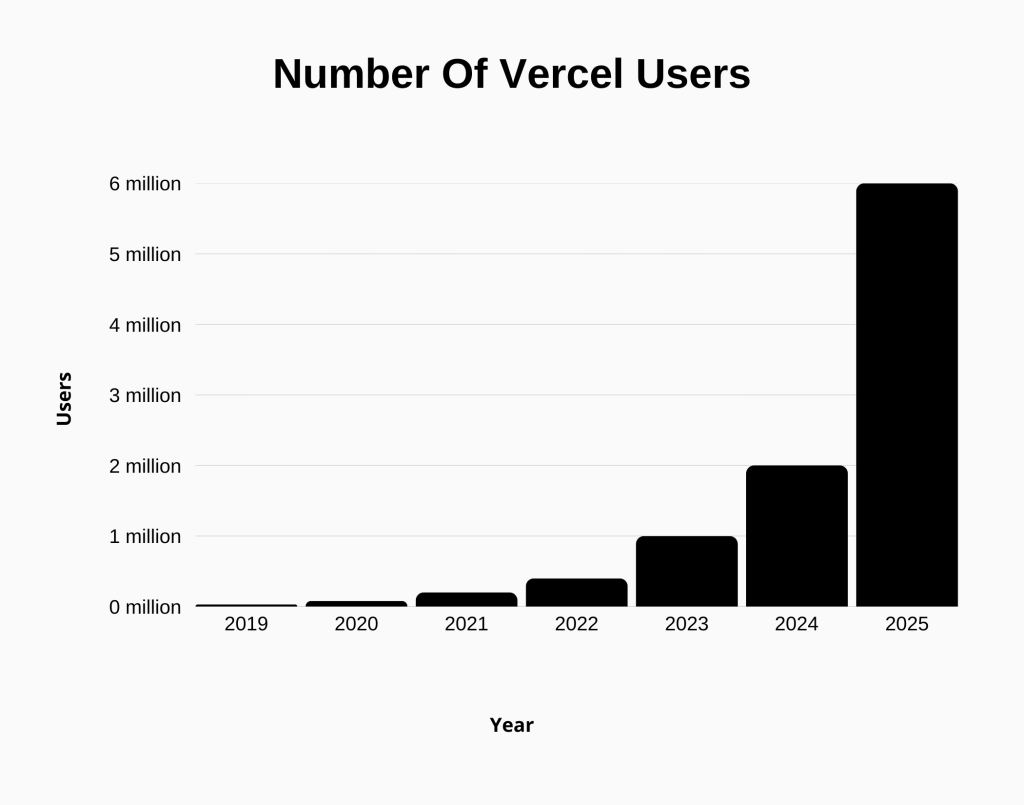
Vercel’s user base has experienced remarkable growth, increasing from around 30,000 developers in 2019 to over 6 million by February 2025.
The platform consistently recorded triple-digit growth during its early years, with an especially notable acceleration between 2021 and 2023, when the number of developers surged from 200,000 to 1 million. This rapid expansion coincides with Next.js becoming the default framework for modern React applications and Vercel’s transition to AI-powered tools.
Vercel expanded from just 2,500 teams in 2019 to over 80,000 active teams by early 2025, demonstrating widespread adoption among both enterprises and startups.
| Year | Estimated Developers Users | % Growth |
|---|---|---|
| 2025 (Feb) | 6,000,000+ users | 200% |
| 2024 | 2,000,000 users | 100% |
| 2023 | 1,000,000 users | 150% |
| 2022 | 400,000 users | 100% |
| 2021 | 200,000 users | 150% |
| 2020 | 80,000 users | 166% |
| 2019 | 30,000 users | — |
| Year | Estimated Team Users | % Growth |
|---|---|---|
| 2025 (Feb) | 80,000+ teams | ~100% |
| 2024 | 40,000 teams | ~82% |
| 2023 | 22,000 teams | ~69% |
| 2022 | 13,000 teams | ~86% |
| 2021 | 7,000 teams | ~75% |
| 2020 | 4,000 teams | ~60% |
| 2019 | 2,500 teams |
Source: Enlyft
Vercel usage stats, geographically
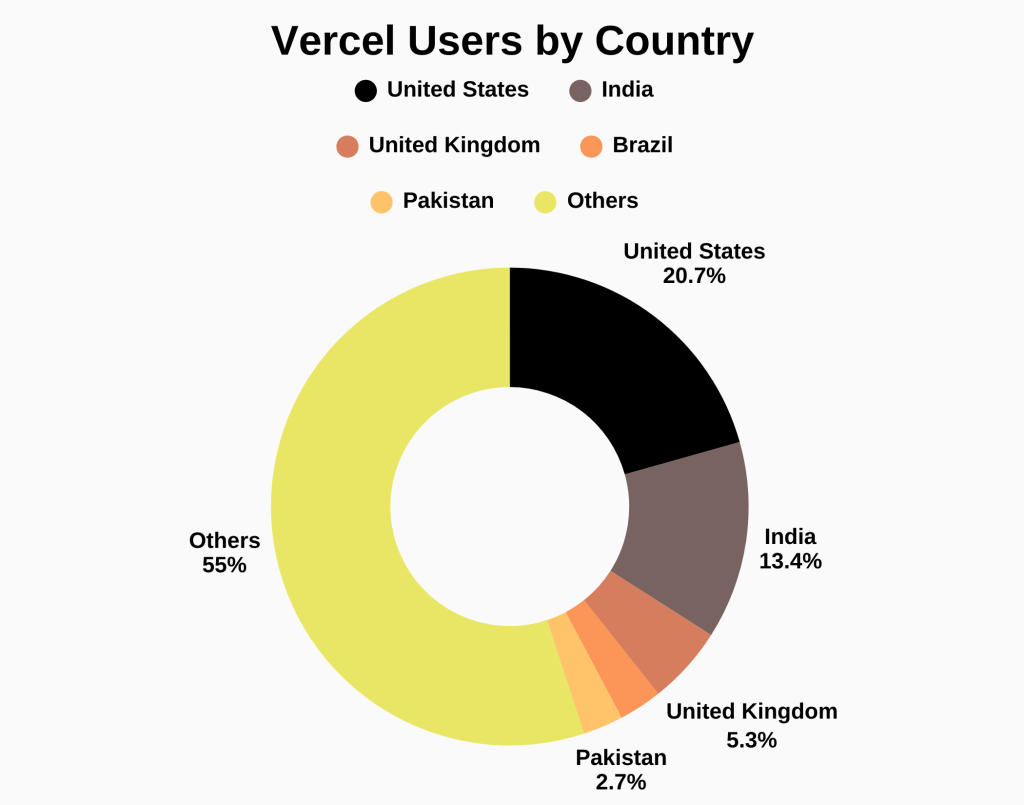
Vercel has a strong presence in North America, South Asia, and Western Europe, with the United States as its largest traffic source, accounting for 20.65% of desktop visits. India follows with 13.38%, driven by a growing developer population. Other significant contributors include the United Kingdom (5.29%), Brazil (2.92%), and Pakistan (2.73%), with Brazil showing notable MoM growth of +18.85%.
The “Others” category (55.03%) reflects Vercel’s reach across over 150 countries, with growing activity in markets such as Nigeria, South Africa, and Egypt. Vercel’s global CDN supports this growth, covering 126 PoPs across 94 cities and 51 countries, expanding its appeal in both established and emerging developer communities.
| Rank | Country | Traffic Share |
|---|---|---|
| 1 | United States | 20.65% |
| 2 | India | 13.38% |
| 3 | United Kingdom | 5.29% |
| 4 | Brazil | 2.92% |
| 5 | Pakistan | 2.73% |
| 6 | Others | 55.03% |
Source: Similar Web
Vercel founder statistics and facts
Vercel was founded by Guillermo Rauch, an Argentine-born self-taught software engineer, in 2015. The company was initially named ZEIT but was rebranded to Vercel in 2020. Rauch grew up in Lanús, near Buenos Aires, where he taught himself Linux and JavaScript as a teenager.
He began freelancing for international clients and contributing to open-source projects before moving to Europe and then to San Francisco to work at various startups. Over the years, he has authored or co-authored several influential projects, including SocketIO, Mongoose, Hyper, and especially Next.js, the React framework that later became the backbone of Vercel’s platform.
Before founding Vercel, Rauch established an education startup called LearnBoost and later Cloudup, which Automattic, the company behind WordPress, acquired. This experience provided him with valuable insights into both building startups and navigating successful exits.
Under his leadership, Vercel has secured multiple funding rounds, including a Series E round at a $3.25 billion valuation in 2024 and a Series F round at a $9.3 billion valuation in 2025. These achievements have firmly positioned Vercel as one of the leading platforms for modern web and AI infrastructure.
As a result, Rauch is widely believed to hold significant personal wealth through his equity in Vercel and previous ventures. However, no credible public sources disclose his exact net worth, and any specific figures you may encounter online are speculative and not based on verified financial disclosures.
Vercel headquarters office
Vercel’s primary headquarters is located in San Francisco, California.
In addition to the main headquarters, Vercel also uses a registered corporate/mailing address in Covina, California:
- Primary Headquarters: San Francisco, California
- Corporate/Mailing Address: 440 N Barranca Ave #4133, Covina, CA 91723, United States
Source: Zoom Info
Vercel employee stats

Vercel’s workforce has expanded rapidly over the past decade, growing from just three employees in 2015 to an estimated 772 in 2025.
| Year | Estimated Employees |
|---|---|
| 2025 | 772 employees |
| 2024 | 575 employees |
| 2023 | 380 employees |
| 2022 | 220 employees |
| 2021 | 100 employees |
| 2020 | 70 employees |
| 2019 | 50 employees |
| 2018 | 30 employees |
| 2017 | 15 employees |
| 2016 | 8 employees |
| 2015 | 3 employees |
About Vercel’s business model
Vercel uses a monetization model combining freemium access, tiered subscriptions, and usage-based billing, allowing developers to start for free and scale into paid tiers as their web applications grow.
At the same time, Vercel generates revenue from its managed frontend and edge infrastructure (CDN + serverless + global deployment) and from enterprise contracts with high-volume, mission-critical use.
Monetization Channels
- Hobby Plan (Free)
- $0/month. Designed for personal projects and small teams. Includes automatic CI/CD, global CDN, preview deployments, and base usage of serverless functions and bandwidth.
- Usage over the free limits triggers either paused projects (on Hobby) or need to upgrade to paid tiers.
- Pro Plan
- $20/month base (one deploying seat included), plus $20 of usage-credit included. Additional paid seats cost $20/month each.
- Includes enhanced features: faster builds, no deploy queue, team collaboration, viewers, and advanced spend management.
- Usage beyond included credit is billed on-demand (functions, bandwidth, ISR, etc).
- Enterprise Plan (Custom Pricing)
- Tailored for large organizations needing advanced security, SLA, compliance (SOC2, HIPAA), multi-region compute, dedicated infrastructure, team/role controls.
- Often involves custom contracts, high volume usage discounts, prioritized support and integration.
- Usage-Based Billing
- Across all paid tiers (especially Pro & Enterprise), Vercel charges for excess usage: serverless functions, data transfer, CDN bandwidth, ISR reads/writes, image optimization, cold start elimination, etc.
- For example: Cold start prevention, higher bandwidth tiers, extra build minutes, large hit events. Origins: Vercel clearly states “$2 per 1M Edge Requests after included 10M”, “$0.15 per GB after first 1TB” etc.
Source: Vercel
Say goodbye to manual coding 🙂
Shipper is the intersection between Vercel V0, code and no-code tools. Building an app is as simple as talking to an AI and letting it do the work for you.
- • AI codes the app
- • Edit visually
- • AI Advisor helps you
- • Go live in 1 click
V0 at a glance
v0 (now v0.app) is Vercel’s AI builder for full-stack web applications, transforming plain-English prompts into functional software, including UI, content, backend logic, and deployment on Vercel’s AI Cloud. It allows users to take ideas from concept to deployment with a single prompt, functioning as an AI teammate rather than just a code generator.
Built with Next.js, React, and Tailwind CSS, v0 produces production-ready code, allowing users to interact through a chat-style interface to create or refine applications. The latest version enables research, debugging, and design iteration, significantly reducing manual prompt cycles.
Vercel positions v0 as an AI pair programmer and versatile app builder, appealing to a wide range of roles, from developers to marketers and non-technical founders. After raising $250 million at a $3.25 billion valuation in May 2024, Vercel focused on further developing v0, its Generative UI product.
By late 2025, v0 is expected to be integrated into Vercel’s broader AI Cloud, with over 3.5 million users and new features such as v0 Mobile for app development using voice and camera input.
Source: Vercel
V0 project deployment statistics
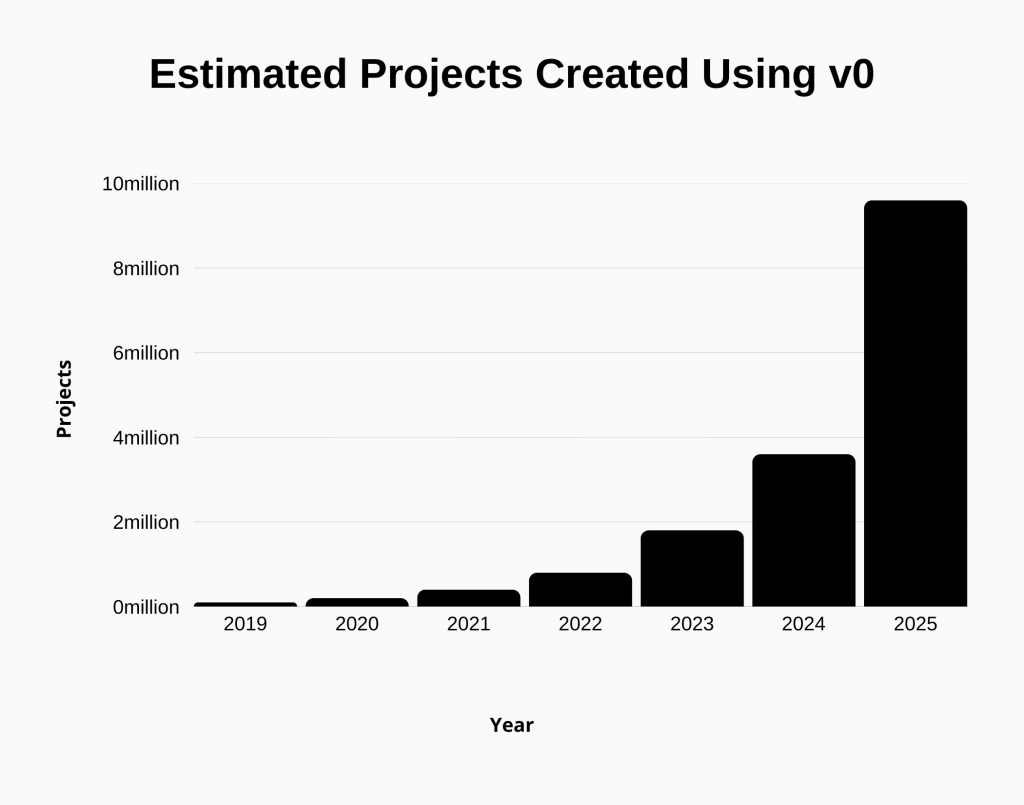
v0 platform is experiencing remarkable growth, with an estimated 9.6 million projects created in 2025 alone.
Developers are the primary drivers of activity, contributing around 7.2 million projects through rapid prototyping and AI-assisted iteration. Teams also play a crucial role, adding approximately 2.4 million projects due to collaborative workflows and increased project throughput. This represents a dramatic increase from previous years; v0 output has nearly quadrupled since 2019, when total project creation was just over 111,000.
The acceleration in project growth is evident year by year: developer-generated projects grew from 36,000 in 2019 to 7.2 million in 2025, while team-generated projects increased from 75,000 to 2.4 million during the same period. Combined annual totals rose from 216,000 projects in 2020 to millions by 2023, illustrating how AI tooling has transformed modern development pipelines.
V0 Developer-Generated Projects
| Year | Total Dev Projects |
|---|---|
| 2025 | 7,200,000 |
| 2024 | 2,400,000 |
| 2023 | 1,200,000 |
| 2022 | 480,000 |
| 2021 | 240,000 |
| 2020 | 96,000 |
| 2019 | 36,000 |
V0 Team-Generated Projects
| Year | Total Team Projects |
|---|---|
| 2025 | 2,400,000 |
| 2024 | 1,200,000 |
| 2023 | 660,000 |
| 2022 | 390,000 |
| 2021 | 210,000 |
| 2020 | 120,000 |
| 2019 | 75,000 |
V0 Final Whole-Number Estimates
| Year | Total Projects Created |
|---|---|
| 2025 | 9,600,000 projects |
| 2024 | 3,600,000 projects |
| 2023 | 1,860,000 projects |
| 2022 | 870,000 projects |
| 2021 | 450,000 projects |
| 2020 | 216,000 projects |
| 2019 | 111,000 projects |
V0 business model analysis
v0 uses a layered business model combining freemium access, tiered subscriptions, and usage-based billing, enabling rapid developer adoption and stable monetization as usage scales.
The strategy begins with a free Individual plan, then scales to higher-value plans as the user’s usage and team size grow. Since v0 is tightly integrated with the Vercel frontend deployment platform (via React/Next.js code generation, etc.), it benefits both individual consumers and enterprise-sized teams.
Monetization Channels
- Free (Individual) — $0/ 0/month
- Core v0 access with limited monthly credits, basic UI generation, and integration with Vercel.
- Premium (Individual) — $20/month
- Higher monthly credit allotment, larger attachment limits, Figma import support, and better performance for individual creators.
- Team Plan — $30/user/month
- Designed for small teams; includes per-user credits, team collaboration features, and centralized billing via Vercel.
- Business Plan — $100/user/month
- For larger teams needing higher credits, shared usage, training opt-out, and API access.
- Enterprise Plan (Custom Pricing)
- Organizations get training opt-out, SAML SSO, role-based access control (RBAC), dedicated compute, and compliance certifications (SOC 2, ISO, HIPAA).
- Usage-based model
- For API access, v0 supports model-token pricing: e.g., $1.50 per 1M input tokens and $7.50 per 1M output tokens for the v0 Agent model.
Source: v0
→ Detailed explanation of V0’s pricing
FAQ: Vercel and V0
1. What exactly is v0 by Vercel?
v0 is an AI-powered UI builder that generates React/Next.js components and full pages from natural-language descriptions. It handles layout, styling, and component logic, producing production-ready code using technologies like React, Tailwind CSS, and shadcn/ui.
2. Is v0 free to use?
Yes. v0 offers a Free plan with limited projects and message credits. The Premium, Team, and Enterprise plans provide higher limits, unlimited projects, and advanced collaboration features.
3. Can I deploy v0-generated projects directly to Vercel?
Yes. Every v0 project can be deployed to Vercel with one click. Environment variables, build settings, and frameworks are automatically configured.
4. What frameworks does v0 support?
v0 primarily generates React, Next.js, Tailwind CSS, and shadcn/ui components. It can also output plain HTML/CSS and limited support for Svelte/Vue via Blocks, but the best experience is on React/Next.js.
4. Is v0 trained on Vercel customer data?
No. v0 is not trained on private customer data from Vercel’slatform or deployments. Your project code remains private and isolated.
Other interesting statistics articles
Cursor | Bolt.new | Lovable | Replit | Windsurf | Base44
Earn 50% + lifetime recurring commissions
Share Shipper with your audience and get paid every month, for life.
Earn 50% + lifetime recurring on every sale
Share Shipper with your audience and get paid every month, for life — no cap on earnings.
Earn 50% + lifetime recurring on every sale
Share Shipper with your audience and get paid every month, for life — no cap on earnings.