40+ Cursor Statistics (2026): Usage, Growth & Revenue


Cursor AI Key Facts (Top Picks)
- Cursor was launched publicly in 2023 and runs on Windows, macOS, and Linux, built on top of Visual Studio Code.
- As of late 2025, Cursor serves over 1 million users, with more than 360,000 paying subscribers and an estimated 36% free-to-paid conversion rate.
- Cursor’s parent company, Anysphere, reached a valuation of $29.3 billion in November 2025 after a $2.3 billion Series D funding round.
- Cursor’s annualized revenue surpassed $1 billion in 2025, making it one of the fastest-growing SaaS products in history, with ARR growing from $1M → $100M in about 12 months, then accelerating past $500M and $1B.
- Cursor is used by millions of developers and tens of thousands of teams at companies such as Nvidia, Adobe, Uber, Shopify, PayPal, Stripe, Coinbase, OpenAI, and Midjourney.
About Cursor as a company
| Company | Information |
|---|---|
| Ownership | Anysphere |
| Year Founded | 2023 |
| Stable Release/ Date | Cursor 2.0 / October 29, 2025 |
| Key Founder(s) | – Michael Truell (CEO) – Aman Sanger – Sualeh Asif – Arvid Lunnemark |
| Operating system | • Windows • macOS • Linux |
| Number of Users | 1 million+ users |
| Number of Employees | 300+ employees |
| Website | cursor.com |
Cursor is an AI-assisted integrated development environment (IDE) that serves as an always-on pair programmer, allowing developers to write, edit, debug, and refactor code through natural language. Derived from Visual Studio Code and launched in 2023 by the San Francisco-based startup Anysphere, Cursor enriches the well-known VS Code environment with extensive AI integrations driven by large language models, including OpenAI’s GPT, Anthropic Claude, and various specialized coding models.
In contrast to traditional autocomplete tools, Cursor operates as a fully AI-native editor, continually indexing the comprehensive codebase, understanding project-wide context, and generating multi-file changes that developers can preview and apply as diffs. Its distinct features include inline chat, codebase-level chat, Smart Rewrite, Bugbot, and multi-model prompting, empowering developers to efficiently scaffold new features, fix bugs, improve performance, and refactor complex systems through conversational instructions.
Currently, Cursor is utilized by millions of developers worldwide and has emerged as a cornerstone in the new generation of AI-accelerated software development. Its swift progression from AI autocomplete capabilities to multifunctional code generation, repository-wide reasoning, and collaborative debugging establishes Cursor as one of the most significant engineering tools within the AI coding revolution.
Cursor Funding Rounds & Valuation
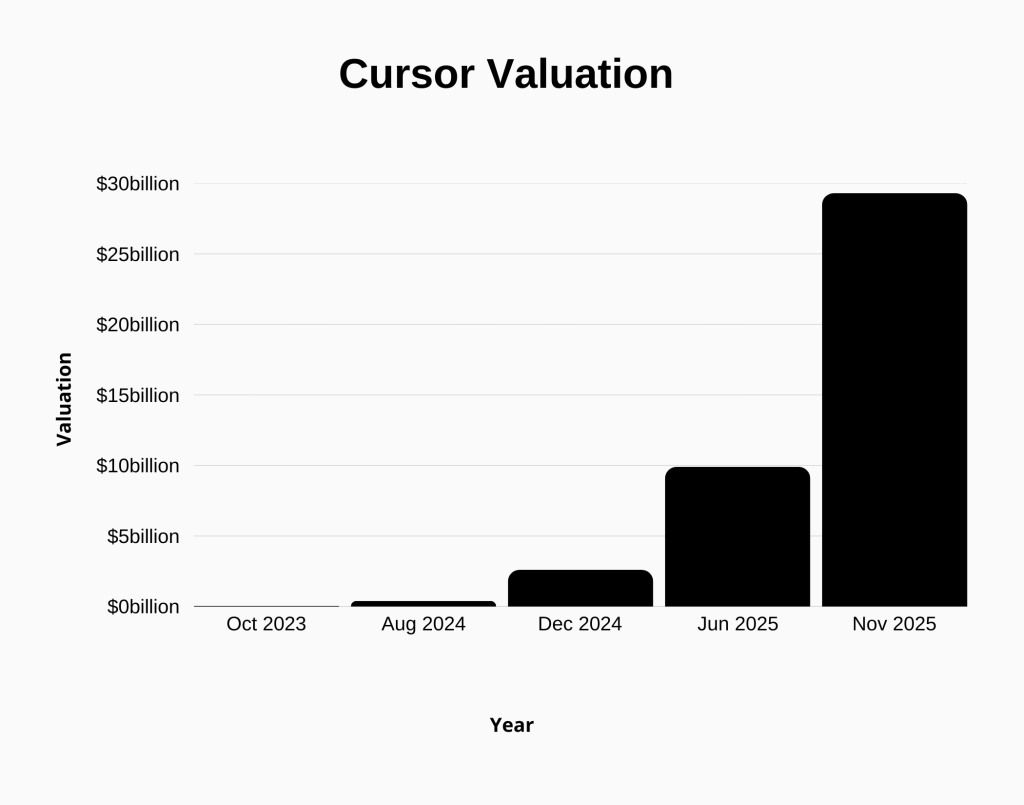
Cursor is currently valued at $29.3 billion in November 2025, following a substantial $2.3 billion Series D funding round led by Accel and Coatue. This valuation surge came just five months after the company closed a $900 million Series C round, valuing it at $9.9 billion and reflecting substantial growth in enterprise adoption and annual recurring revenue (ARR).
In December 2024, Cursor successfully raised $105 million in Series B funding, increasing its valuation to approximately $2.6 billion, as Thrive Capital and Andreessen Horowitz reaffirmed their support. Before this, in August 2024, Cursor secured $60 million in Series A funding, which valued it at $400 million and marked its entrance into the broader AI development ecosystem.
The company’s impressive growth began with an $8 million seed extension in October 2023, backed by the OpenAI Startup Fund, Nat Friedman, and Arash Ferdowsi. Cursor’s journey officially commenced in April 2022, when the founding team raised $400,000 in pre-seed capital.
| Date | Funding Round | Amount Raised | Post-Money Valuation | Lead Investors |
|---|---|---|---|---|
| Nov 2025 | Series D | $2.3 billion | $29.3 billion | Accel, Coatue |
| Jun 2025 | Series C | $900 million | $9.9 billion | Thrive Capital, Accel |
| Dec 2024 | Series B | $105 million | ~$2.6 billion | Thrive Capital, Andreessen Horowitz |
| Aug 2024 | Series A | $60 million | $400 million | Andreessen Horowitz, Thrive Capital |
| Oct 2023 | Seed (Extension) | $8 million | ~$50 million (implied) | OpenAI Startup Fund, Nat Friedman, Arash Ferdowsi |
| Apr 2022 | Pre-Seed | $400,000 | – | – |
Source: Crunchbase, Forbes, Tech Crunch
Cursor Revenue Growth (ARR)
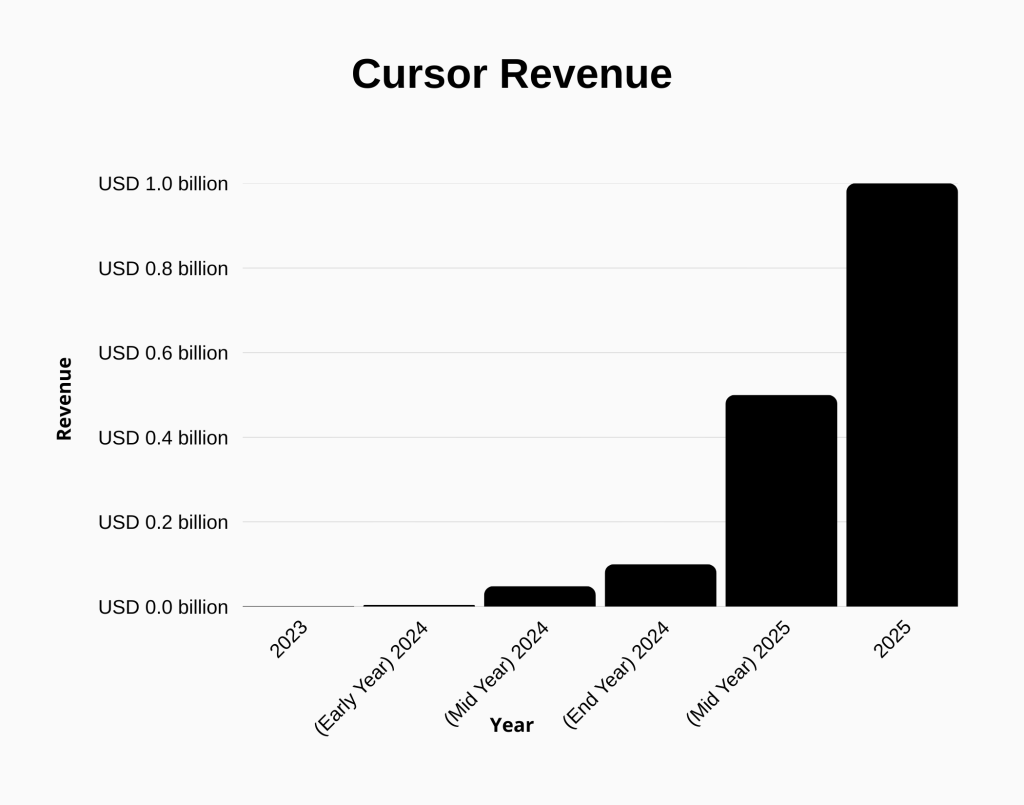
Cursor has experienced unprecedented revenue growth, achieving one of the fastest financial accelerations in the software-as-a-service (SaaS) industry. By May 2025, Cursor reached annual recurring revenue (ARR) of $500 million, a remarkable increase from $300 million the previous month, representing an extraordinary 60% month-over-month gain.
This remarkable expansion enabled Cursor to surpass $1 billion in annualized revenue by late 2025, a milestone substantiated by several reports, including those from CNBC. A significant driver of this momentum has been the notably high conversion rate of free-trial users to paid subscriptions, with developers opting for the $20 Pro and $40 Business tiers at conversion rates that greatly exceed standard SaaS benchmarks.
Initially propelled by individual developers, Cursor’s growth entered a subsequent phase marked by substantial adoption among enterprise teams, accelerating revenue beyond initial projections. Prominent companies, including OpenAI, Midjourney, Shopify, Perplexity, Nvidia, Uber, and Adobe, now constitute vital components of its customer base. With widespread adoption among millions of developers globally and rapid expansion of enterprise licensing, Cursor is recognized as the fastest-growing SaaS product in history, eclipsing records set by firms such as Wiz, Deel, and Ramp.
| Year | Revenue |
|---|---|
| 2025 | $1 billon+ |
| 2025 (Mid-Year) | $500 million |
| 2024 (End-Year) | $100 million |
| 2024 (Mid-Year) | $48 million |
| 2024 (Early-Year) | $4 million |
| 2023 | $1 million |
Source: CNBC, Medium, Tech Crunch
Cursor Users Growth (Developers)
As of late 2025, Cursor had surpassed 1 million total users, with more than 360,000 subscribers. This achievement resulted in an impressive 36% conversion rate, one of the highest recorded for a developer-centric AI tool.
During the same period, enterprise adoption skyrocketed, exceeding 50,000 seats as engineering teams within Fortune 1000 companies standardized on Cursor for their daily development tasks. Just a few months prior, in mid-2025, Cursor had already achieved a user base of 850,000, propelled by hyper-viral product-led growth within organizations such as Stripe, Coinbase, Rippling, and Upwork. By the end of 2024, the platform had crossed the 500,000-user milestone and registered one of the swiftest revenue increases in the Software as a Service sector, soaring from $100 million to $300 million in annual recurring revenue in record time.
The growth observed in early 2024 was similarly robust, with the user base expanding from 100,000 to 250,000 users. This increase was primarily due to significant migration from tools such as GitHub Copilot, as developers favored Cursor’s deeper AI integration. Adoption rates surged from the initial phases, with Cursor onboarding 10,000 early testers in 2023, which subsequently validated its strong product-market fit ahead of general availability.

| Year / Period | Total Users | Paying Users | Conversion Rate | Enterprise Seats |
|---|---|---|---|---|
| 2025 (Late) | 1,000,000+ | 360,000+ | 36% | 50,000+ |
| 2025 (Mid-Year) | 850,000 | 300,000 | 35% | 40,000 |
| 2024 (End-Year) | 500,000 | 150,000 | 30% | 20,000 |
| 2024 (Mid-Year) | 250,000 | 60,000 | 24% | 8,000 |
| 2024 (Early) | 100,000 | 20,000 | 20% | 2,000 |
| 2023 | 10,000 | 2,000 | 20% | – |
Cursor Pricing & How Cursor Makes Money
Cursor operates on a tiered subscription model with usage-based billing for individual developers and large organizations. It offers a free Hobby plan with limited AI usage and a two-week Pro trial for evaluation.
The main paid option is the Pro plan at $20 per month, which includes unlimited Tab completions, access to the “Auto” model, and a monthly $20 credit for premium AI models. For power users, the Ultra (Power) plan is available at $200 per month, offering significantly more usage and priority execution.
For engineering teams, the Teams plan costs $40 per user per month and includes centralized billing, usage analytics, and administrative controls. Larger enterprises can choose Enterprise licensing with custom pricing and additional features like SAML SSO and dedicated support.
Cursor also includes the Bugbot product, with the Pro Bugbot priced at $40 per month for automated code reviews on up to 200 pull requests. Bugbot Teams and Enterprise plans mirror the general team structure.
These revenue streams, including subscriptions, usage credits, team plans, enterprise contracts, and Bugbot services, contribute to Cursor’s high-margin business model and significant annual recurring revenue growth.
| Plan | Price (Monthly) | What You Get |
|---|---|---|
| Hobby (Free) | $0 | Limited Agent requests, limited Tab completions, two-week Pro trial. |
| Pro | $20 | Unlimited Tab, unlimited Auto-model usage, $20/month credit pool for premium models, faster completions. |
| Ultra / Power | $200 | All Pro features + ~20× usage pool, higher limits, priority access to new features. |
| Teams | $40/user | All Pro features + centralized billing, usage analytics, org privacy controls, admin panel. |
| Enterprise | Custom | SAML SSO, SCIM, RBAC, pooled credits, compliance (SOC 2), invoice billing, dedicated support. |
| Bugbot Pro | $40 | Unlimited reviews for up to 200 PRs monthly + rule-based review system. |
| Bugbot Teams / Enterprise | $40/user or custom | Unlimited PR reviews across teams, shared rules, org-wide controls. |
Source: Cursor, Cursor Bugbot
How many Apps have been built with Cursor?
Cursor is not a no-code builder with a public app counter, but its massive developer base and high code-generation volume enable statistical estimation of project output. Between early 2023 and late 2025, Cursor grew from a small community tool into an AI coding engine used by over 1 million developers, 360,000+ paying users, and 50,000+ enterprise teams.
By combining user adoption, enterprise usage, and reported project activity, estimates suggest Cursor has supported the creation of hundreds of thousands of applications, ranging from internal enterprise systems to fully deployed SaaS products. Cursor’s growth accelerated sharply alongside improvements to its model and rising enterprise adoption.
From fewer than 20,000 estimated apps in 2023, Cursor usage expanded to over 900,000 apps by late 2025, reflecting a steep multi-year acceleration driven by AI-assisted development.

| Period | Estimated Number of Apps Built with Cursor |
|---|---|
| 2025 (Late) | 900,000+ apps |
| 2025 (Mid-Year) | 700,000+ apps |
| 2024 (End-Year) | 400,000+ apps |
| 2024 (Mid-Year) | 200,000+ apps |
| 2024 (Early) | 80,000+ apps |
| 2023 | 20,000+ apps |
Like Cursor, but for non-coders.
Tools like Cursor help you write code faster, but they still expect you to be the engineer. Shipper flips that around by taking a single prompt and turning it into a working product you can ship instantly.
- • 1 prompt to a full app
- • No manual setup
- • Design and logic generated
- • Go live in 1 click
Cursor Usage by Geography
Cursor is experiencing strong global adoption, particularly in North America, East Asia, South Asia, and Latin America.
The United States leads with 18.81% of traffic, driven by enterprise usage and early adoption in Silicon Valley. China follows at 11.22%, showing a notable increase despite regional constraints. India contributes 9.94%, fueled by a growing developer community interested in AI-assisted coding.
Brazil is growing rapidly at 3.66% (+20.37%), while South Korea’s growth is 3.12%. The “Others” segment accounts for 53.24%, indicating Cursor’s wide reach across more than 100 countries.

| Rank | Country | Traffic Share |
|---|---|---|
| 1 | United States | 18.81% |
| 2 | China | 11.22% |
| 3 | India | 9.94% |
| 4 | Brazil | 3.66% |
| 5 | Republic of Korea | 3.12% |
| 6 | Others | 53.24% |
Source: Similar Web
Who Founded Cursor? (Founder Background & Net Worth)
Cursor was founded in 2022 by four MIT graduates under the parent company Anysphere, Inc. The founders are:
- Michael Truell (CEO)
- Aman Sanger
- Sualeh Asif
- Arvid Lunnemark
The team met while studying at MIT and began building internal AI coding tools in 2022 before launching Cursor publicly in 2023. Their vision was simple: automate software engineering by creating an AI-native code editor capable of generating, editing, and understanding entire codebases.
Cursor grew at historic speed. As of late 2025, Anysphere (Cursor’s parent company) had:
- Crossed $1 billion in annualized revenue
- Scaled to millions of developers
- Reached a $29.3 billion valuation after its $2.3 billion Series D
- Built one of the world’s most-used AI coding models (“Composer”)
This valuation instantly made all four young founders, each in their mid-20s, billionaires.
According to Forbes (Nov 2025), each founder holds approximately 4.5% of Anysphere’s equity. Estimated Net Worth per Founder (2025) Based on Forbes reporting and the $29.3B post-money valuation.
| Founder | Role | Background | 2025 Estimated Net Worth |
|---|---|---|---|
| Michael Truell | CEO | MIT; built “Halite” programming game; ex-Google, Octant | ~$1.3B |
| Aman Sanger | Co-founder | MIT; Neo Scholar | ~$1.3B |
| Sualeh Asif | Co-founder | From Karachi; International Math Olympiad competitor | ~$1.3B |
| Arvid Lunnemark | Co-founder (Left in 2025) | MIT; Math Olympiad champion | ~$1.3B |
Source: Forbes
Where is Cursor’s head office located?
Cursor’s parent company, Anysphere, Inc., is headquartered in San Francisco, California.
33 New Montgomery Street, Suite 1500 San Francisco, CA 94105 United States
Source: Bloomberg
Cursor Employees Headcount
Cursor is poised to become known for having one of the leanest teams in history, achieving over $300 million in ARR with fewer than 100 employees and surpassing $1 billion in ARR shortly after reaching 300 employees.
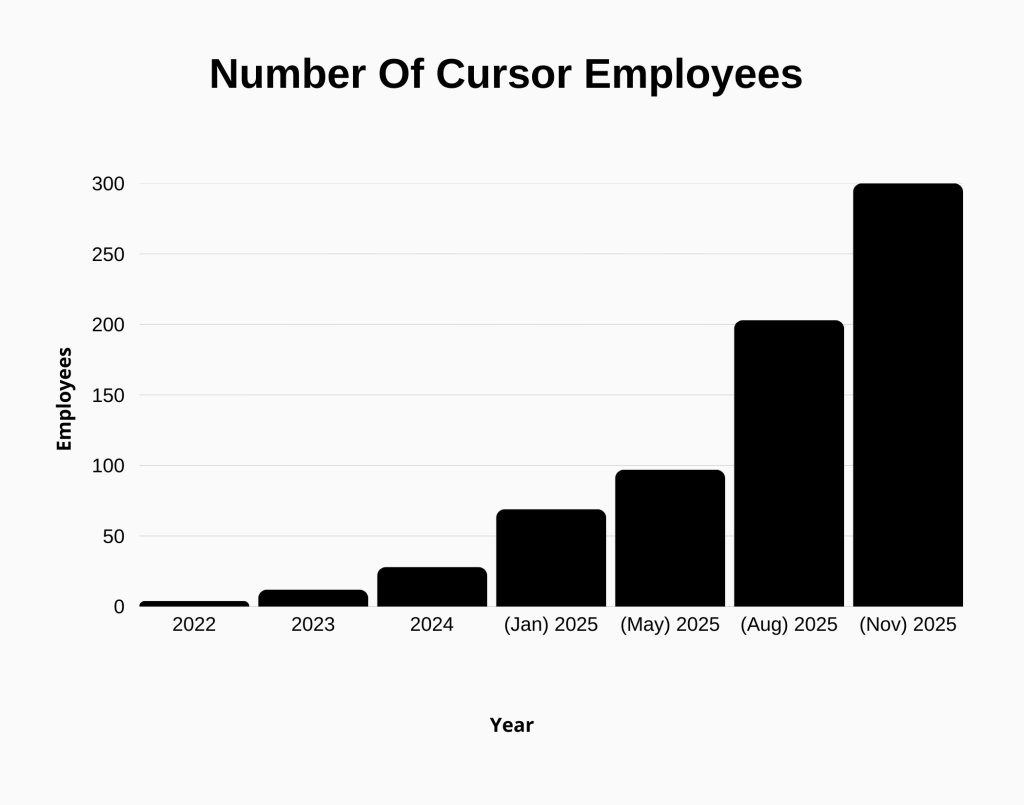
| Year | Cursor Estimated Employees Headcount |
|---|---|
| 2025 (Nov) | 300 employees |
| 2025 (Aug) | 203 employees |
| 2025 (May) | 97 employees |
| 2025 (Jan) | 69 employees |
| 2024 | 28 employees |
| 2023 | 12 employees |
| 2022 | 4 employees |
Cursor FAQs
1. Is Cursor free?
Yes. Cursor offers a free Hobby plan that includes limited AI usage, basic features, and a two-week Pro trial. Students can also access one year of Cursor Pro for free through the Student Program.
2. Does Cursor replace GitHub Copilot?
Not directly.
Copilot is built primarily for in-line code completion, while Cursor is a full AI-native IDE with deeper context awareness, multi-file editing, agents, and project-wide understanding. Many developers use both tools together.
3. What AI models does Cursor support?
Cursor supports models from:
- OpenAI
- Anthropic
- xAI
- Cursor’s in-house model: Composer
Users can also attach their own API keys for additional model options.
4. Does Cursor store my code?
Organizations on Teams and Enterprise can enable Privacy Mode, ensuring that code never leaves your machine, is not stored on Cursor servers, and is not used for model training.
Cursor is SOC 2 certified and maintains enterprise-grade security controls.
5. Is Cursor safe for enterprise use?
Yes. Enterprise features include:
- SOC 2 certification
- SAML/OIDC SSO
- Role-based access control
- SCIM provisioning
- Privacy Mode
- Centralized billing and admin tools
Cursor is used by engineering teams at Nvidia, Adobe, Uber, PayPal, Shopify, Stripe, and Coinbase.
Other interesting statistics articles
Vercel | Bolt.new | Lovable | Replit Windsurf | Base44
Earn 50% + lifetime recurring commissions
Share Shipper with your audience and get paid every month, for life.
Earn 50% + lifetime recurring on every sale
Share Shipper with your audience and get paid every month, for life — no cap on earnings.
Earn 50% + lifetime recurring on every sale
Share Shipper with your audience and get paid every month, for life — no cap on earnings.