20+ Windsurf Statistics to Know in 2026


Key Windsurf Statistics
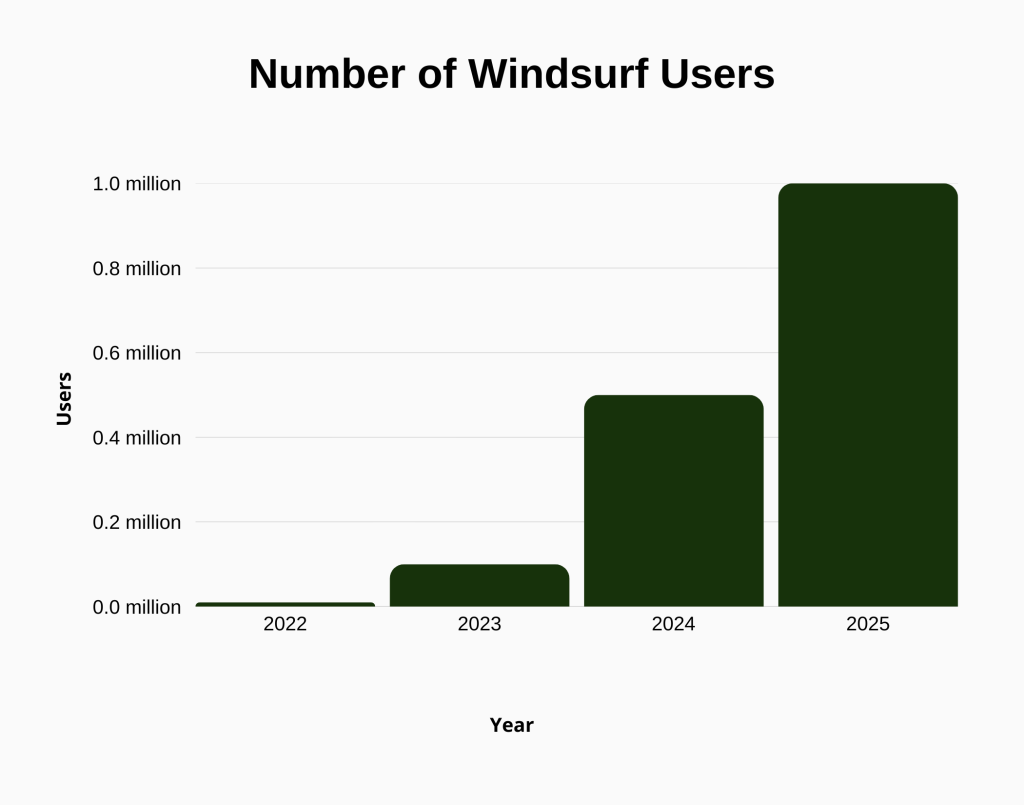
- Windsurf crossed the 1M user mark less than two years after launch, placing it among the fastest-growing AI developer tools of its generation.
- At the time of the Cognition AI acquisition, Windsurf maintained extremely high daily engagement, driven by intensive project-wide AI usage.
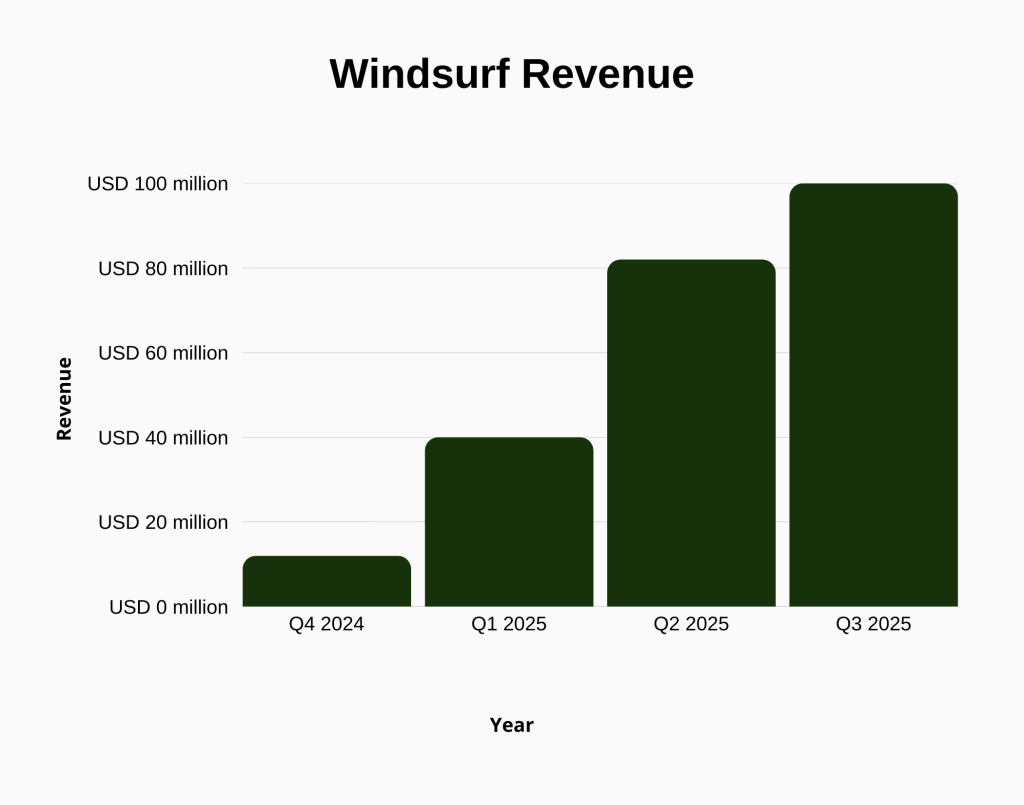
- Windsurf ARR grew from $12 million (Q4 2024) → $82 million (Q2 2025) → $100 million (Q3 2025), showing one of the fastest enterprise expansions in AI tooling.
Windsurf Overview (About the Company)
| Company | Information |
|---|---|
| Industry | Software |
| Year Founded | 2023 |
| Key Persons | – Varun Mohan (CEO) – Jeff Wang (President) |
| Offices | United States (HQ) |
| Number of Users | 1 million users (as of 2025) |
| Services | – AI-powered coding IDE – Cascade agent – Windsurf Tab – MCP integrations, enterprise & government deployments (FedRAMP High, DoD IL5, ITAR) |
| Website | windsurf.ai |
Windsurf is an AI-native software company building one of the most advanced coding environments available today. The platform combines an intelligent IDE, an agentic system called Cascade, and a suite of productivity tools designed to keep developers in continuous flow. Launched by Varun Mohan and his founding engineering team, Windsurf focuses on transforming software creation through human-AI collaboration rather than pure automation.
The company began development in 2023 and quickly established a presence across the U.S., operating with a distributed team and a strong engineering footprint. Windsurf now supports more than 1 million developers and works with over 4,000 enterprise customers, including teams that require high security and compliance standards such as FedRAMP High, DoD IL5, and ITAR.
Windsurf’s core offering centers on the Windsurf Editor, an AI-native IDE that integrates code understanding, real-time multi-file reasoning, and execution tools directly into the workspace. Cascade handles complex codebase tasks, anticipates intent, and performs multi-step edits, while Windsurf Tab provides streamlined navigation, imports, and execution with a single keystroke. A growing ecosystem of MCP integrations, plugins, and first-class model support reinforces these capabilities.
The company’s mission is grounded in a simple idea: individuals and organizations have far more potential than today’s tools allow. Windsurf aims to remove friction from the development process, enabling engineers to ship faster, explore larger ideas, and work through complex systems without breaking focus. With an expanding product line and an acquisition by Cognition, Windsurf has positioned itself as a major force shaping the future of AI-powered software development.
Source: Windsurf
Windsurf Revenue
Windsurf became one of the fastest-growing AI developer tools, driven by enterprise adoption and individual developer usage. The company grew from a small base in 2023 to a nine-figure ARR by mid-2025, fueled by demand for AI-native IDEs and agent-assisted coding.
Revenue accelerated consistently: early growth came from pro subscriptions, while 2025 momentum came from enterprise and federal customers. With Cognition’s acquisition in July 2025, Windsurf was scaling faster than most competitors in agentic coding.
Enterprise revenue doubled quarter over quarter before the acquisition.
External sources place ARR between $82 million and $100 million at deal time, making Windsurf one of the highest-earning AI development platforms behind GitHub Copilot and Cursor.
| Period | Estimated Revenue |
|---|---|
| Q3 2025 | $100 million |
| Q2 2025 | $82 million |
| Q1 2025 | $40 million |
| Q4 2024 | $12 million |
Source: Windsurf
Windsurf Funding Rounds & Valuation
Windsurf’s valuation grew from $500 million in January 2024 to $10.2 billion by July 2025, a 20× increase in 18 months, reflecting one of the fastest AI tooling accelerations.
The Series C round on August 29, 2024, raised $150 million at a $1.25 billion valuation, making Windsurf a unicorn with backing from General Catalyst, Kleiner Perkins, and Greenoaks.
By early 2025, the valuation reached $2.85 billion, a 128% increase in under six months, driven by enterprise growth and IP breakthroughs (Fast Context, SWE-1.5).
Cognition AI acquired Windsurf on July 14, 2025, for $10.2 billion, a 258% increase from early 2025 and one of the largest AI developer tools acquisitions. No new capital was raised; growth was driven by strategic value and IP.
Windsurf moved from mid-stage to acquisition at extraordinary speed, powered by enterprise demand, strong economics, and breakthroughs in agent-assisted coding.
| Date | Round / Event | Capital Raised | Post-Money Valuation | Key Investors / Counterparties |
|---|---|---|---|---|
| Jul 14, 2025 | Acquisition by Cognition AI | – | $10.2 billion | Cognition AI |
| Early 2025 | Valuation Step-Up (pre-exit) | – | $2.85 billion | Existing institutional investors |
| Aug 29, 2024 | Series C | $150 million | $1.25 billion | Led by General Catalyst; participation from Kleiner Perkins and Greenoaks |
| Jan 30, 2024 | Series B | $65 million | $500 million | Led by Kleiner Perkins; participation from Greenoaks and General Catalyst |
Source: Windsurf, Windsurf, Crunchbase, CNBC
Windsurf is great if you want to code. Shipper is great if you want the product built.
Windsurf gives you an incredible coding environment with agents that help you refactor, fix, and extend your project. You’re still the engineer. Shipper is for the other path, where you just explain the idea and skip straight to something you can use or share without touching code.
- • Windsurf: deep code editing
- • Shipper: one prompt to a full app
- • Windsurf: multi-file refactors
- • Shipper: design and logic generated
Windsurf User Growth (Windsurf Developers’ Adoption)
Windsurf’s developer base grew from tens of thousands (2022) → 500,000+ (2024) → 1 million+ (2025), a ~20× increase in three years.
As of July 2025, the daily active users on windsurf reached hundreds of thousands, signaling strong engagement and retention at scale.
Enterprise adoption surged from hundreds (early 2024) → 4,000+ (mid-2025), a 10× jump in 18 months. Individual developers committed 44.6% AI-generated code on average, evidence of deep product reliance.
| Period | Estimated Developers’ Adoption |
|---|---|
| 2025 | 1 million+ developers |
| 2024 | 500,000+ developers |
| 2023 (Beta Year) | 100,000+ developers |
| 2022 (Initial Release) | 10,000+ developers |
How many Projects are developed using Windsurf?
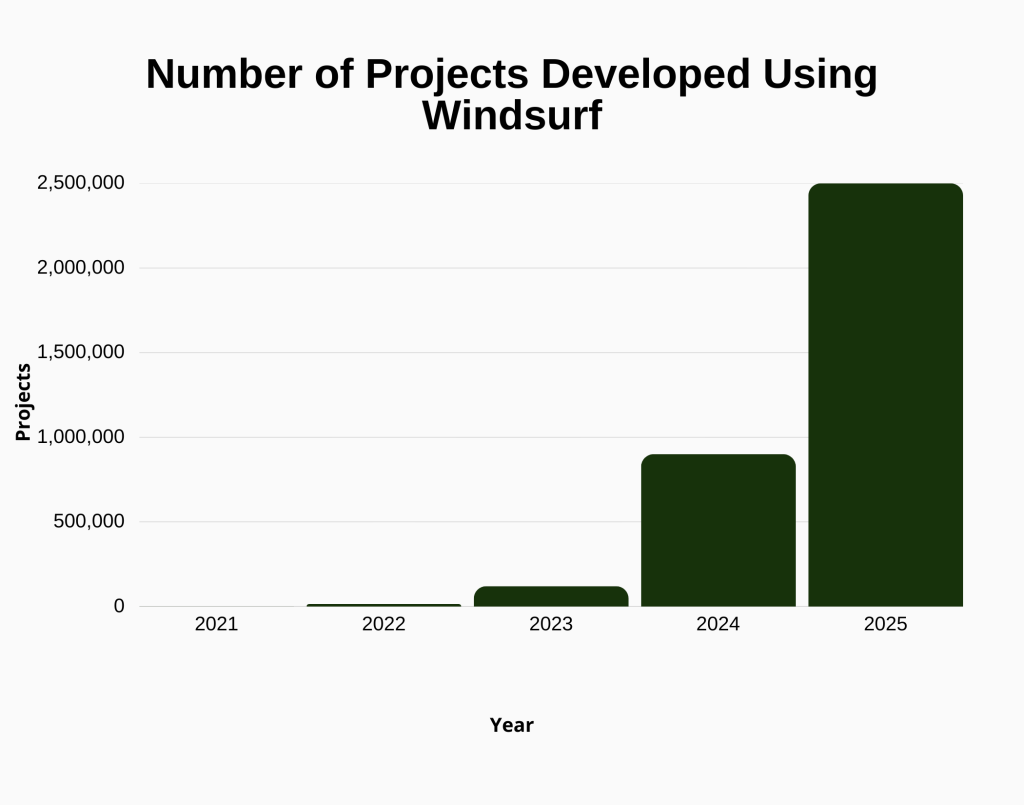
Windsurf’s growth follows a classic hockey stick trajectory.
In 2021-2022, it started as an AI assistant for code suggestions and automation, supporting thousands of projects while building credibility and gathering feedback.
By 2023, developer trust in AI tooling crystallized. Windsurf matured significantly, adding indispensable features. Project creation climbed to tens of thousands as early adopters became evangelists, proving genuine product-market fit.
2024 brought acceleration. With 200,000–500,000 users, Windsurf scaled its go-to-market team and began enterprise onboarding. The platform’s complex workflow capabilities attracted larger organizations, exploding project creation into the hundreds of thousands.
2025 marked the explosion phase. With over 1 million developers, Windsurf crossed a critical threshold. AI-generated code became the norm. Enterprise deployments validated reliability and security, while multi-file logic generation and workflow automation accelerated development, resulting in over 3 million projects globally and a dramatic increase in throughput per user.
| Year | Estimated Projects |
|---|---|
| 2025 | 2.5 million projects |
| 2024 | 900,000 projects |
| 2023 | 120,000 projects |
| 2022 | 15,000 projects |
| 2021 | 500 projects |
Source: Windsurf, Windsurf, Windsurf
Windsurf Usage by Geography
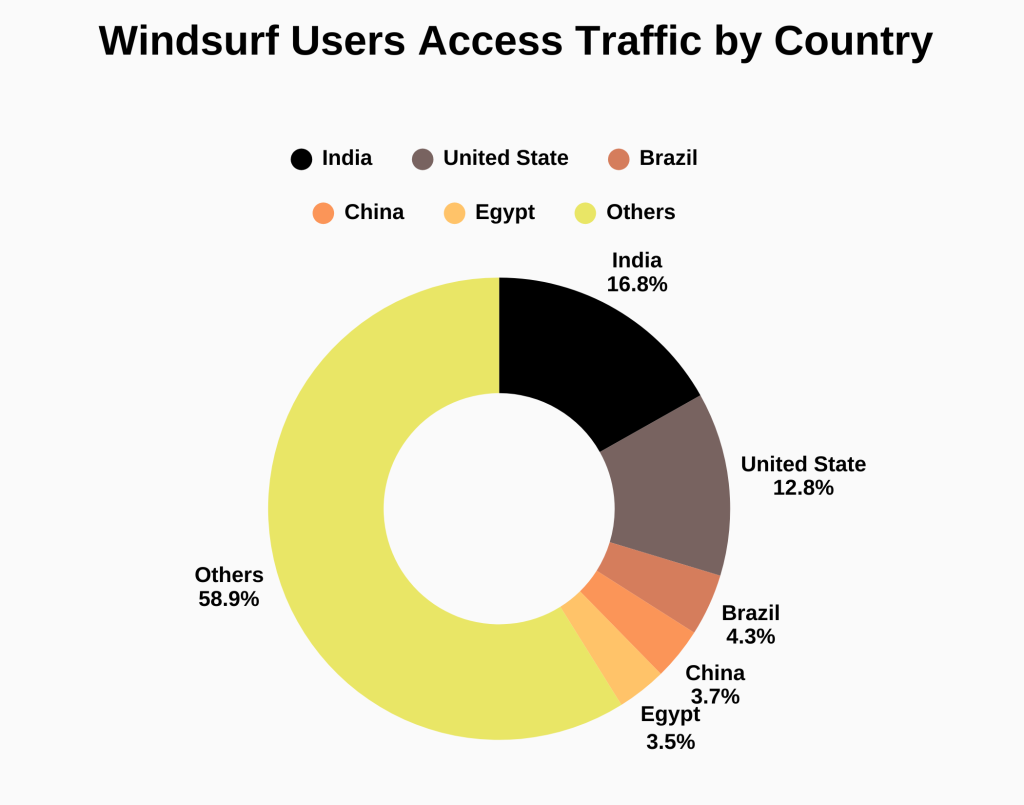
India leads with 16.83% of total usage, followed by the United States at 12.84%. Beyond the top two, Brazil shows 4.33% usage, while Egypt holds 3.46%. China, at 3.66%.
Most critically, “Others” account for 58.87% of usage, meaning over half of Windsurf activity comes from smaller markets.
| Country / Region | Share of Usage (%) |
|---|---|
| India | 16.83% |
| United States | 12.84% |
| Brazil | 4.33% |
| China | 3.66% |
| Egypt | 3.46% |
| Others | 58.87% |
Source: Similar Web
Windsurf Pricing (How Windsurf Makes Money)
Windsurf operates on a tiered subscription system supported by a credit-based usage model, allowing both individual developers and large engineering teams to scale their consumption according to workload.
The platform earns revenue through recurring monthly subscriptions, usage-based credit consumption, and the sale of additional “Flex” credits when users exceed their plan limits. This hybrid model positions Windsurf as a predictable SaaS business with strong potential for variable-usage revenue.
| Plan | Price | Included Credits | Key Features | Add-On Credits |
|---|---|---|---|---|
| Free | $0/month | 25 credits/month | Basic models, unlimited Tab completions, inline edits, app previews | Not available |
| Pro | $15/month | 500 credits/month | Premium models, Fast Context, SWE-1.5 agent model | $10 for 250 credits |
| Teams | $30/user/month | 500 credits/user/month | Centralized billing, analytics, priority support, zero data retention | Add-on credits available |
| Enterprise (≤ 200 users) | From $60/user/month | 1,000 credits/user/month | SSO, RBAC, highest priority support | Add-on credits available |
| Enterprise (200+ users) | Contact sales | Custom | Hybrid deployment, account management, volume discounts | Add-on credits available |
| Flex Credits | Over-limit usage | 250 credits = $10 (Pro), 1,000 credits = $40 (Teams/Enterprise) |
Source: Windsurf
About The Windsurf Team
Windsurf was founded in June 2021 by Varun Mohan and Douglas Chen, two MIT classmates who met in middle school. Their expertise in computer science, machine learning, and large-scale systems shaped the company’s direction.
Varun Mohan: Co-founder and Former CEO
Varun Mohan was born in Sunnyvale, California. He attended The Harker School before MIT, where he earned a B.S. and M.Eng. in Electrical Engineering and Computer Science, with a focus on distributed systems, algorithms, and machine learning.
Before joining Nuro as a Lead Software Engineer specializing in deep learning infrastructure, Mohan interned at LinkedIn, Quora, Samsung, Cloudian, and Databricks.
Mohan co-founded Windsurf (originally Exafunction, later Codeium) while exploring GPU virtualization. After GPT-3.5’s release, he pivoted to an AI-native IDE for software development.
In July 2025, Mohan left via a $2.4 billion deal with Google DeepMind, joining Google’s AI coding initiatives.
Douglas Chen: Co-founder
Douglas Chen, also an MIT graduate and Mohan’s long-time friend, worked at Meta building developer tools for Oculus Quest. His systems engineering background complemented Mohan’s infrastructure expertise.
Chen co-led Windsurf’s GPU virtualization focus before the pivot to AI developer tools. He joined Google DeepMind in July 2025 as part of the same deal.
Founder Net Worth (Estimates)
Varun Mohan and Douglas Chen’s personal net worth is not publicly disclosed.
- Google’s $2.4 billion deal (July 2025) included
- $1.2 billion for licensing rights to investors
- $1.2 billion in compensation for ~40 team members
- A significant portion of the $1.2 billion went to Mohan and Chen.
- Windsurf was valued at $1.25 billion (Aug 2024) and $2.85 billion (Feb 2025).
- Cognition AI acquired the remaining assets for ~$250 million.
P.S.: While the payout made them extremely wealthy, there is no verified evidence that either became a billionaire; the $2.4 billion refers to total deal size, not personal net worth.
Source: Yahoo Finance, Economic Times
Windsurf Employee Count
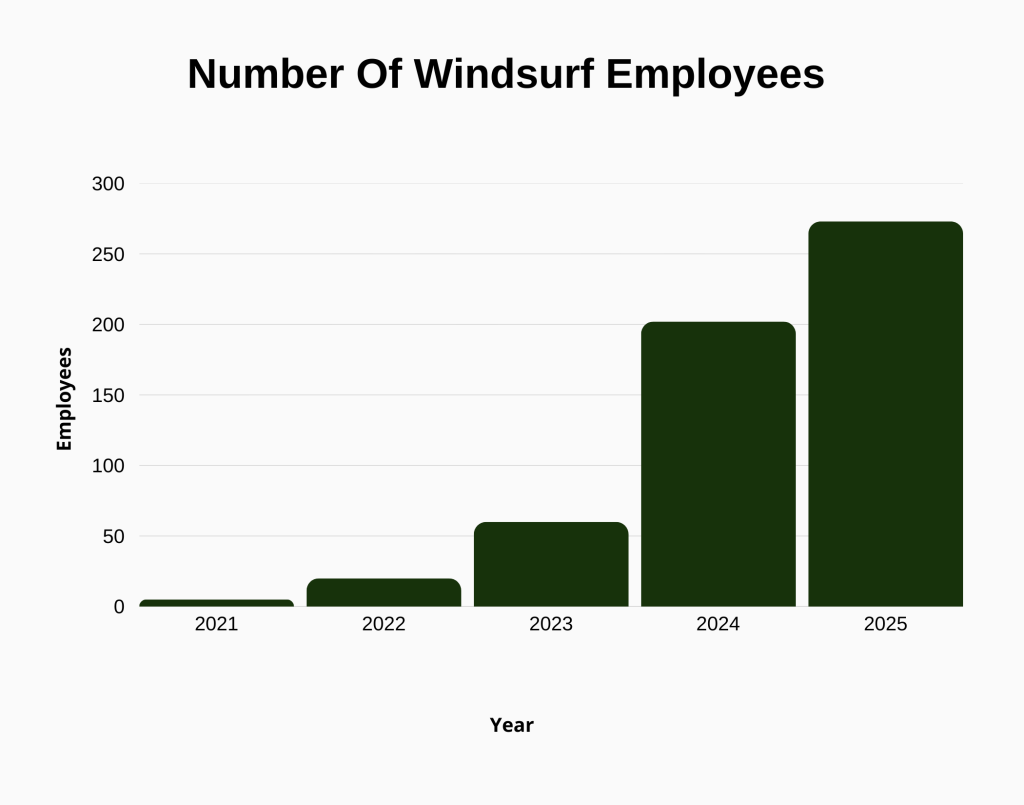
Windsurf grew from 5 employees in 2021 to 273 by 2025, a 54.6× increase, reflecting rapid product-market fit and strong investor support.
Growth accelerated post-2022. By 2023, headcount reached 60 (200% YoY), coinciding with the shift to the Codeium/Windsurf platform. In 2024, it tripled to 202 employees as enterprise adoption surged.
The largest jump occurred in 2025, adding 71 employees to reach 273. This aligned with ARR growth from $12M to over $100M, matching patterns of high-performing SaaS companies.
Windsurf’s headcount CAGR from 2021 to 2025 was approximately 192% per year, highlighting its rapid scaling before mid-2025 acquisition activity.
| Year / Period | Estimated Employee Count |
|---|---|
| 2025 | 273 |
| 2024 | 202 |
| 2023 | 60 |
| 2022 | 20 |
| 2021 | 5 |
Source: Tech Crunch
Windsurf is great if you want to code. Shipper is great if you want the product built.
Windsurf gives you an incredible coding environment with agents that help you refactor, fix, and extend your project. You’re still the engineer. Shipper is for the other path, where you just explain the idea and skip straight to something you can use or share without touching code.
- • Windsurf: deep code editing
- • Shipper: one prompt to a full app
- • Windsurf: multi-file refactors
- • Shipper: design and logic generated
FAQ: Windsurf
1. Is Windsurf free?
Yes. Windsurf offers a free plan that includes 25 prompt credits each month, unlimited Tab completions, inline edits, and access to basic model capabilities.
This tier allows developers to test the IDE, explore workflows, and evaluate its performance on real projects before upgrading to a paid plan. Paid tiers (Pro, Teams, and Enterprise) unlock premium models, higher credit limits, and advanced features.
2. Does Windsurf replace Cursor or VS Code?
Windsurf can replace Cursor or VS Code, but it can also work alongside them.
Technically, Windsurf is a VS Code fork enhanced with an AI-first editor, deeper automation features, and agentic workflows. Developers who prefer the VS Code environment can import their existing settings directly into Windsurf.
In practice:
- Windsurf performs better on large or complex codebases, thanks to Fast Context and its integrated agent system.
- Cursor is often preferred for smaller projects or quick prototyping.
So Windsurf doesn’t just replace existing editors, it expands what developers can do inside them.
3. What AI models does Windsurf use?
Windsurf supports a combination of leading frontier models and its own proprietary models.
Available options include:
- Claude 3.5 Sonnet
- GPT-series models
- Gemini models
- Grok/xAI models
- Windsurf SWE-1.5, a fast agent model built for structured reasoning
- Windsurf Fast Context, optimized for large-scale codebase understanding
This hybrid model approach gives users flexibility from quick autocomplete tasks to multi-step agentic workflows on enterprise-level projects.
4. Does Windsurf store code or train on it?
Windsurf does not train its models on user code.
However, it does temporarily process code for context awareness and workflow continuity. It works in two ways:
- Indexed code chunks are sent for remote embedding computation but are returned and stored locally, not retained by the provider.
- Workflow files and instructions are stored inside a local
.windsurfdirectory, which teams may commit to source control for collaboration.
This setup ensures privacy while still enabling the deep project understanding required for agent-level coding.
5. Is Windsurf safe for enterprise use?
Yes. Windsurf is built with enterprise security requirements at its core.
It offers compliance-ready features such as:
- Zero data retention (Teams and Enterprise)
- SSO and RBAC
- Encrypted indexing
- On-premise or hybrid deployment options
- Proprietary models designed specifically for secure, large-scale code work
Many large organizations use Windsurf because its architecture minimizes data exposure and offers more controlled workflows than many competing AI IDEs.
Other Statistics Articles
Lovable | Bolt.new | Cursor | Vercel & V0 | Replit | Base44
Earn 50% + lifetime recurring commissions
Share Shipper with your audience and get paid every month, for life.
Earn 50% + lifetime recurring on every sale
Share Shipper with your audience and get paid every month, for life — no cap on earnings.
Earn 50% + lifetime recurring on every sale
Share Shipper with your audience and get paid every month, for life — no cap on earnings.